
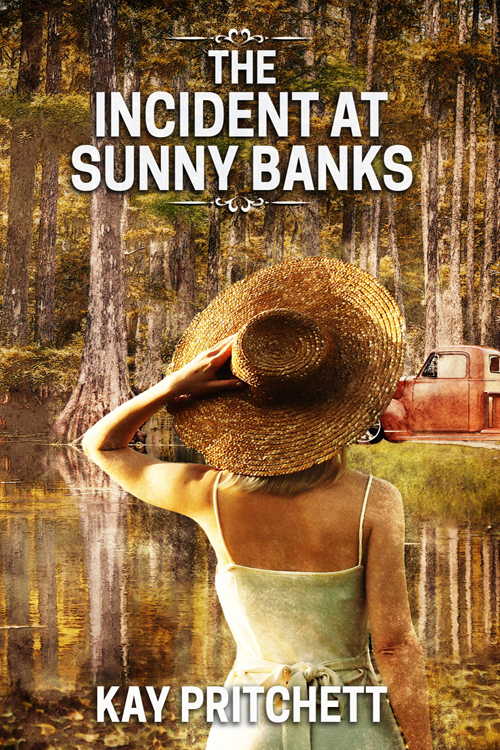
Please join me in welcoming author Kay Pritchett. Today, Kay is sharing a guest post about how her novel came to be set along the Mississippi River and details some interesting history behind Victorian homes. Mystery readers are sure to enjoy meeting a new amateur sleuth in The Incident at Sunny Banks.
ABOUT THE BOOK:
Title: The Incident at Sunny Banks
Author: Kay Pritchett
Genre: Mystery
BLURB:
Mosey Frye, real estate agent and amateur sleuth, comes upon a corpse in the garage at Sunny Banks, the home of local towboat magnate Martin Eldridge. Hembree police chief Lieutenant Gus Olivera tracks a lead on a man who tried to extort money from the Captain Jack crew, claiming they were intoxicated on the night of a fatal collision. But Mosey, ever inquisitive, sets her sights on the Eldridges’ distant past and ultimately reveals a more devious plot to destroy the elderly riverman’s legacy and take control of his company.
GUEST POST:
The Role of Place in Storytelling: No Place like Home
When I start a novel, nothing drives me like the allure of place, especially the place I hail from, the Mississippi River Delta, a mysterious land that abounds in untold tales just waiting to be shared. Though I haven’t lived in my hometown of Greenville, Mississippi (once known as the Queen City of the Delta) since my high school days, this enigmatic place evokes a sense of nostalgia, a mélange of scents, sounds, hues, and textures that have left an indelible mark on my soul.
When it comes to this very special place, it’s hard to say which inspires a writer more: living there or not living there. During the years of my residency, writing about “God’s country” didn’t really interest me. It wasn’t until I had put some time and space between me and it that I understood the significance of my homeland in my life. Only then did I endeavor to fathom it, first, in memory, and later, in fiction.
So how does “place” come together in a novel? I started by crafting the quaint town of Hembree, set on the west bank of the Mississippi River. By keeping the town fictional and locating it in Arkansas rather than my home state, I figured I could steer clear of potential drama from friends and relatives claiming to recognize some character or event in the story. Then came the buildings, crucial, of course, to the plot, seeing as my amateur sleuth is a real estate agent and every mystery commences with a listing. I’ve come across many intriguing abodes in the Delta, from the storied shotgun shack to the tumbledown mansion. Yet, in creating my mystery series, I have most often gravitated toward the Victorian style house, and research has validated this inclination.
Victorian dwellings, you see, are considered creepy for more than just appearance’s sake. In fact, some sociological underpinnings contributed to their adoption as the ideal haunted house. Krystal D’Costa, in answering the question, “Why are Victorian houses haunted?” for the Scientific American blog (October 27, 2016), claims that when Victorian homes were first built, their wealthy owners were often seen as cold-hearted because they appeared to value money above all else. Before long, folks began to feel wary of the recently affluent and projected those sentiments onto their residences. Critics of the Victorian have also noted that these wooden dwellings, full of nooks and crannies, are a challenge to keep up. I can vouch for that, as I call one such beauty—or monstrosity—my home. If you don’t have cleaners and handymen coming around regularly, it’s likely your Victorian will look shabby, with paint chipping, boards coming loose, and spiderwebs taking over the veranda.
After settling on the Victorian style, I dove into exploring interiors and got carried away playing with décor, furnishings, and all kinds of what-nots. It’s convenient that my protagonist Mosey Frye’s best friend is an antique dealer who picks up treasures at estate sales, like old trunks, wardrobes, and even taxidermy mounts, quite favored by Victorians. An innocuous item like a hair receiver can play a central role in a mystery. The one I featured in The Terrace held hair strands laced with arsenic! In another mystery, The House with the Secret Cellar, a dusty oil painting discovered in a hidden cellar provided dirt on a prominent Hembree family.
Not all novelists like putting “place” front and center, but for me, it has conjured up a wealth of elements. And seeing as these things tie back to my own heritage, they come to me loaded with emotion, which, of course, is essential to storytelling. I have an indescribable connection with my made-up world: the scenery, buildings, and interiors, whether cozy or forbidding. While it’s all make-believe, the fantastical roots sink deep into the Delta, as deep as the roots of the legendary cypress trees around Greenville that, reaching down to the aquifer, color the water a faint shade of brown.
AUTHOR BIO:
Kay Pritchett, a native of Greenville, Mississippi, lives in Fayetteville, Arkansas, where she taught Spanish literature at the state’s flagship university. At retirement, she threw herself into fiction writing and has wrapped up six books in the Mosey Frye Mystery series. As a mystery writer, she delights in blending the charming wit of amateur sleuth Mosey Frye with the suave sophistication of police chief Gus Olivera. She’s all about sprinkling her mystery novels with lively banter, highlighting the dynamic interactions between Mosey and her trusty sidekick Nadia, as well as the intriguing dialogues between Olivera and sharp-witted coroner Eads McGinnis. Her goal? To transport readers into the thrilling world of an Agatha Christie whodunit, but with a delightful twist—think verandas and paddle boats! Murder in High Cotton (2022), inspired by childhood memories of theDelta, anthologizes her first short mystery novels. She launched her full-length novels, The Summer House at Larkspur (Book #4) and The Incident at Sunny Banks (Book #5), soon after in 2023. The House with a Secret Cellar (Book #6) has reached the final stages of editing and will enter production soon, so get ready for another wild ride with Mosey Frye Mysteries!

SOCIAL MEDIA LINKS:
PURCHASE LINKS:


Place is significant when I read, I need to be able to feel what the characters are feeling and location is relevant to that. I like that you’re using a location you’re familiar with, sometimes you can tell when the author only knows details from research versus experience and it impacts the way the story flows. Great article!
LikeLiked by 1 person
I agree. There’s nothing like a well-written setting to bring a story to life. Thank you for stopping by.
LikeLiked by 1 person