
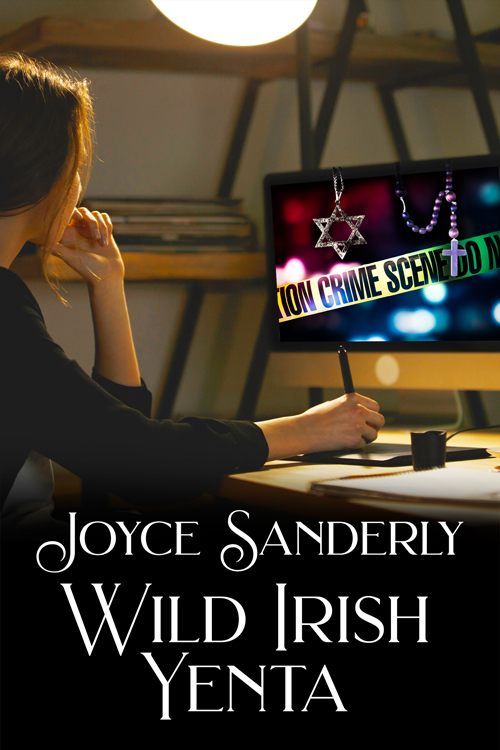
Author Joyce Sanderly is joining us today for an interview. I am also pleased to share a character interview with the protagonist from her women’s fiction novel. If you’re a fan of romance, mystery, and laughs, you are sure to enjoy Wild Irish Yenta.
ABOUT THE BOOK:
Title: Wild Irish Yenta
Genre: Women’s Fiction with a bit of mystery, romance, and humor
Author: Joyce Sanderly
BLURB:
Set against a backdrop of a suburban Maryland synagogue, Wild Irish Yenta dishes on interfaith marriage, misbehaving clergy, Biblical myth, and the beauty of religious traditions. When the body of custodian Roberto Gomez is found in Temple Israel’s parking lot, Patricia Weiss, nee Reilly, exchanges her suburban-mom sneakers for gumshoes to investigate the hit-and-run. An ardent new convert to Judaism, Patricia is grappling with her outsider status at the upscale Reform congregation. For Roberto, the stakes had been much higher. He was struggling to be adopted by a new country and learn a new language. Inspired by her detective dad, Patricia is compelled to find out who-dun-it and why.
This novel takes a wry look at marriage, insular suburban cliques, and the politics of religious institutions. While poking fun at cultural stereotypes, the novel interweaves biblical stories with questions of contemporary concern. Can a nice Catholic girl find happiness with a Jewish cardiologist even if she converts? Can Patricia’s yenta patrol detect a connection between a custodian’s death and other troubling happenings at the Temple?
“In Wild Irish Yenta, Philip Roth meets Agatha Christie, and the result is a page-turner that also explores the interlocking dynamics that exist within an interfaith marriage, a family and a Maryland synagogue.” — Michelle Brafman, author of Swimming With Ghosts.
“This keenly observed, funny mystery … combines an insightful look at interfaith marriage, the complexities of friendship, and the politics of religious institutions.” – Susan Coll, author of Bookish People
Wild Irish Yenta (The Wild Rose Press, traditional channel, released May 1, 2024)
Page count 346, Print price $18.99, digital price $5.99
ISBNs 978-1-5092-5093-6 Paperback, 978-1-5092-5094-3 Digital
Available on Amazon, Barnes & Noble, Bookshop
INTERVIEW:
Welcome! It is my pleasure to feature your novel.
When did you begin writing?
Ever since I was a young girl, I have wanted to write fiction and poetry. Given the economic necessities of life and my parents’ limited resources, I realized I had to pursue a profession that would enable me to support myself and my family. I practiced law for the federal government for many years and raised my family in the Washington, D.C. area. But when my sons began to pursue their independent interests, I began to pursue my own passion to write poetry and fiction.
What was the inspiration behind Wild Irish Yenta?
The story for Wild Irish Yenta began with a focus on the conflicts surrounding an interfaith marriage. My own experience of the difficulty of finding clergy to officiate at my interfaith marriage was the impetus. As the plot formed, I researched customs, doctrine and biblical interpretations of Christianity, Judaism and Islam. I researched how evidence is used to track leads, interview witnesses, and rule out suspects. I also researched aspects of securities law and criminal law related to the plot of Wild Irish Yenta.
What has been your biggest challenge as an author?
I find formulating plots for a full length work of fiction to be challenging. I am a big fan of a number of mystery authors: Laura Lippman, Megan Abbott, Tana French (Irish), Jane Harper (Australian) and Lianne Moriarty (also Australian). These writers explore the multi-faceted relationships among family, friends, lovers, and enemies. Their novels delve into the psychological impetus behind their characters’ crimes. I find the interplay among characters and their motivations for crossing over the legal line to be fascinating. I have attempted to follow in the footsteps of these authors in crafting a story that explores the interlocking dynamics that exist within an interfaith marriage, a family, a friendship and the politics of religious institutions. However, the complexities of these relationships has to be balanced against the pacing of the plot so that the reader is compelled to keep turning the page. The plot also must be realistic enough to be believable – at least with some small leaps of imagination – but not so realistic as to become boring. Finally, I find writing fiction requires discipline. Time must be devoted to research, writing, and revising.
What project are you currently working on?
I am taking a breather from novel writing for a few months and concentrating on poetry. My debut poetry collection The Shomer (written under Ellen Sazzman) came out two years ago, and I have had poems published recently in Clackamas Review, Atlanta Review, Folio, Peregrine, Delmarva Review, Another Chicago Magazine, Sow’s Ear, and Lilith, among others. I am in the process of putting together a second book of poetry. However I already have a crime in mind awaiting the sleuthing skills of Patricia and Brenda. I plan to write Wild Irish Yenta Returns in the near future.
What writing advice would you like to share?
Perhaps every writer feels like a beginner at the start of each new project. So my advice should be taken “with a grain of salt.” First I think an author needs to find a topic that is of interest to herself as motivation to keep going with the project. Second I suggest an author plow ahead and try to finish a complete draft so as not to get stuck on perfecting individual chapters. What is that saying – perfection is the enemy of good progress? Third I found belonging to a writers group whose members give honest feedback was very helpful in crafting a final draft. Finally I try to dedicate morning hours to writing projects and to delay phone calls and social engagements until later in the day when I am less productive. (Unfortunately I have been less successful ignoring those endlessly seductive emails.) I am convinced everyone has a story to tell. It’s just a matter of sitting down to write it.
Character Interview with Patricia Weiss, protagonist-narrator of Wild Irish Yenta
Tell us a bit about yourself and the title of the book?
Wild Irish Yenta, yes, that’s me, Mrs. Patricia (nee Reilly) Weiss, wife of a Jewish cardiologist and daughter of good Catholic parents. My Italian-American mother is a nurse and a dynamite cook. I followed my mother’s path into nursing. Unfortunately I did not inherit her culinary gene, much to the dismay of my foodie husband and my adorable four-year-old son. My Irish- American dad was a detective in the Randolph, Massachusetts police force and I did inherit his love of solving crimes and puzzles.
My addictive attraction to puzzling is one of the reasons I was compelled to investigate the mysterious death of Roberto Gomez, the custodian at my family’s temple in suburban Maryland. His body was found in the temple’s parking lot squashed against a garbage bin. I had been tutoring Roberto with his English language skills. Roberto was struggling to be adopted by a new country, learn a new language, and hold down a job to support his family. I felt a kinship with him. I, too, felt like an outsider. As a recent convert to Judaism, I was trying to gain acceptance into the Jewish faith, the temple, and my husband’s family (especially my mother-in-law). In spite of my overly cautious doctor-husband’s wishes, my temple buddy Brenda and I designated ourselves the Yenta Patrol to unravel the mystery.
What is a yenta you may ask. As with most Yiddish words, there is no precise English equivalent. My buddy Brenda defines yenta as a wise and knowledgeable female who distributes essential information to parties who have a need to know, kind of like an analog version of social media. A less complimentary definition of the term yenta might be “busybody.” In any event Brenda and I made a great detecting team, and we had good intentions at heart.
What made you choose nursing as a profession/career?
I was encouraged to follow my mother into nursing. My mother managed to take good care of both her patients and her family. She cooked amazing meals – lasagna and peach pie – and made sure she was home while my father worked long and unpredictable hours. I followed my mother’s nursing path in hopes that I could simultaneously pursue a caring profession and raise a family. Although other women of my generation were going into law and medicine, none seemed to live in Randolph. I enjoyed my nursing responsibilities in the hospital. Plus I met my handsome husband when he was a resident in cardiology at the hospital. But when my son Danny was born, I decided to be a full-time mom. My husband was just establishing his cardiology practice in Maryland, and I wanted to ensure I was available to give Danny hugs and meet his needs.
In retrospect, I might have chosen differently. If I had been a boy I might have followed my father into the police force and become a detective. However, a detective can be put in compromising situations where she has to intimidate witnesses and bend the truth to obtain the truth. It’s not like being a firefighter. No one is happy to see a detective on the doorstep with a search warrant. In an ideal world with unlimited resources of time and money, I think I would have pursued a medical career. Perhaps I would have become an infectious disease doc or a pathologist who unraveled medical mysteries. In any event, I am going to encourage my son (and hopefully more children to come) to follow his heart and mind when choosing a career.
What is your biggest fear?
My biggest fear is not being the best mother I can be for Danny, my four-year-old son. He is such a smart, sweet child. He shares with friends and asks lots of questions. I want to encourage him to be curious, to try new things, but I don’t want to pressure him or stress him out. I wish I could ensure him a happy life, but I know that is impossible. He will have to face many challenges by himself. I can only provide a safe and loving environment and give him as many opportunities as possible. I wish I knew when to protect and when to pull back. My parents were good parents but they were very traditional, and I was raised in a different era. The world has become a much complicated place, what with social media, global warming, and pandemics. I hope I can raise Danny to be a caring person and to have the tools he needs to make fulfilling choices.
What is the best piece of advice you have ever received?
The best recent pieces of advice I have received come from my mentor Rabbi Deborah who guided me through the conversion process and from my buddy Brenda. Rabbi Deborah has convinced me that I need to be more accepting of my husband’s behavior, my mother-in-law’s behavior, and my own behavior. No one is perfect, and I need to learn to be more forgiving of all of our flaws. At the same time, Rabbi Deborah has emphasized that I should not give up on pursuing my own interests outside of the family. Rabbi Deborah has also emphasized that a married couple must be loving and beloved friends, passionate partners for life. Brenda, the most experienced spouse of the three of us, has made clear that marriage is a 50/50 proposition – both partners must share the responsibilities and the fun times equally.
AUTHOR BIO:
Joyce Sanderly is a Pushcart-nominated poet and an attorney. She retired as a Senior Counsel at the U.S. Securities and Exchange Commission. Her poetry (written under Ellen Sazzman) has been published in numerous journals, and her poetry collection, The Shomer, was selected as a finalist for the Blue Lynx Prize, a semifinalist for the Elixir Press Antivenom Award and the Codhill Press Poetry Award. She has lived in Washington, D.C. and Montgomery County, Maryland for the last forty years where she raised her family and practiced law for the federal government. Wild Irish Yenta is her debut novel.
SOCIAL MEDIA:
To learn more about Joyce Sanderly and her writing go to:
PURCHASE LINKS:
 Jill Piscitello